

WhatsApp Icon

Free delivery(excluding XL and glass transport)

Ordered before 14:00, dispatched today

Delivered from stock

Your purchase is protected with Trusted Shops Trustmark

Tagged with 'Beschermde diersoorten'

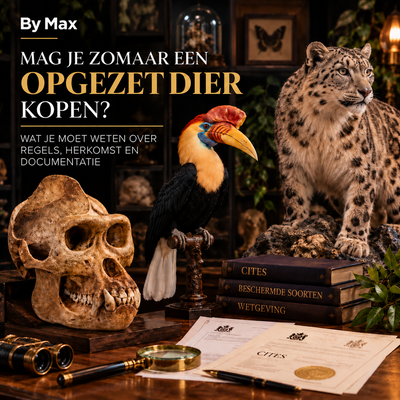
Can you just buy a taxidermy animal?

Taxidermy animals and taxidermy with attention to provenance and documentation

A beautiful taxidermy animal can be a special object for an interior, collection or enthusiast. But are you allowed to buy and sell any taxidermy animal just like that?

The short answer is: No, not always.

Legal rules on possession, purchase and sale apply to some animal species. This is mainly related to the protection of wild animals and plants. CITES plays an important role in this, but it is not the only legislation that may need to be taken into account.

Anyone buying a taxidermy animal would therefore do well to look not only at the appearance and quality of a specimen, but also at the species, origin and any accompanying documentation.

Not every taxidermy animal is subject to the same rules

A taxidermy animal is not automatically the same as a live animal in legal terms. However, rules for protected species can also apply to dead animals, specimens and parts thereof.

The first question is therefore always: What animal species is it?

Some species are covered by CITES. Other species may, for example, be subject to European or Dutch protection regulations. The rules can also differ depending on the species, the origin of the animal and what you want to do with the specimen.

The Netherlands Enterprise Agency (RVO) and the Netherlands Food and Consumer Product Safety Authority (NVWA) provide information on this and supervise various aspects of the regulations concerning protected animals and products derived from them.

What does CITES have to do with this?

CITES is an international agreement that regulates trade in certain wild animals and plants. The rules are intended to prevent international trade from posing a threat to the survival of species.

CITES is not only about live animals. Products and parts from protected animals can also fall under the regulations. A taxidermy animal can therefore also fall under them.

Depending on the species and the situation, documents, certificates, markings or other evidence may be required. It may also make a difference whether a specimen is purchased within the European Union, imported from another country or exported to another country.

You can read more about CITES and its significance within taxidermy in our article What is CITES?.

Why is the origin of a taxidermy item important?

For protected species, it is important that the legal origin of a specimen can be demonstrated.

The mere fact that an animal has existed for a long time or has been part of a collection for years does not automatically mean that it may be traded without further documentation.

In the trade of protected species, proof of legal origin can therefore play an important role. Depending on the situation, this proof may consist of, for example, CITES documents, transfer documents, markings or other documents showing the origin.

At By Max, sales begin before going online.

At By Max, we consider this one of the most important aspects of offering taxidermy.

Before a taxidermy specimen is offered to us, we check which animal species it is, its origin and which documentation applies. When specific documents or permits are required for a taxidermy specimen, these must be in order before the animal is offered.

We do not want our customers to face any surprises afterwards. That is why we consider accurate administration and demonstrable provenance to be just as important as the quality and appearance of the specimen itself.

This is certainly very important for protected species.

Can you bring a taxidermy animal back from abroad?

This is often where it gets extra complicated.

A specimen that is offered for sale without issue in another country may not automatically be brought into the Netherlands without further formalities. For protected species, specific permits or certificates may be required for import.

Even when it concerns an old specimen or an animal product, it is important to check in advance which rules apply. The rules may also differ by species and by country.

Anyone wishing to bring a protected animal or product thereof into the Netherlands would therefore be wise to do this in advance to check with the competent authority.

What should you look out for as a buyer?

When you want to buy a taxidermy animal, there are a number of questions you can ask yourself:

  • What animal species is it exactly?
  • Does this species fall under CITES or other protection regulations?
  • Where does the specimen come from?
  • Is the legal origin demonstrable?
  • Are the required documents or other supporting evidence present?
  • Are there specific conditions associated with ownership or trade?
  • Do you want to take the specimen to another country or sell it there later?

Especially with unusual or protected animal species, it is wise to ask these questions for the purchase to ask.

At By Max, we check these matters before a taxidermy specimen is offered. The required documentation must be in order before an animal is put up for sale with us.

Why is documentation also important for the buyer?

Good documentation is not only important for the seller. As a buyer, you also want to know what you are buying and whether the provenance of a specimen can be demonstrated.

This becomes important, for example, if you later want to sell, move or take a taxidermy specimen to another country. Depending on the species and the situation, rules may apply again.

A purchase is therefore not only about the physical specimen. For protected species, the associated administration and documentation are also part of the animal’s story.

And what about at By Max?

Over the years, By Max has owned thousands of specimens and works with a highly diverse collection of taxidermy animals, skulls, skeletons and other naturalia.

Precisely because of that large collection, we consider it important to handle origin and regulations carefully.

Checking the correct documentation is not a final step for us after an animal has been sold. It is an important part of the process before a taxidermy specimen is even offered.

In doing so, we look at the species, its origin and the documents that apply to the specimen in question.

When relevant documentation is available for a taxidermy specimen, we can of course provide information about it.

In addition to taxidermy animals, you will also find an extensive collection at By Max skulls and skeletons. More information about our collection and working methods can be found on our About us page.

Check it before you buy

Buying a taxidermy animal is therefore not always as simple as choosing and taking home a decorative object.

For many species, there are no particular issues, but for protected animals specific rules and documentation may apply.

Not sure whether a specimen may be bought or sold? First check the species, its origin and the applicable regulations.

RVO and NVWA provide information about protected animals, CITES and the rules surrounding possession, transport and trade. If in doubt about a specific situation, it is advisable to contact the competent authority in advance.

At By Max, we believe it is important that customers can purchase a taxidermy specimen with complete peace of mind. That is why, for us, a proper sale starts with proper provenance and the correct documentation.

Please note: regulations concerning protected animals and CITES may change. The information in this article is intended as a general explanation and does not replace individual legal advice. If in doubt, always check the current regulations and information from the competent authorities.
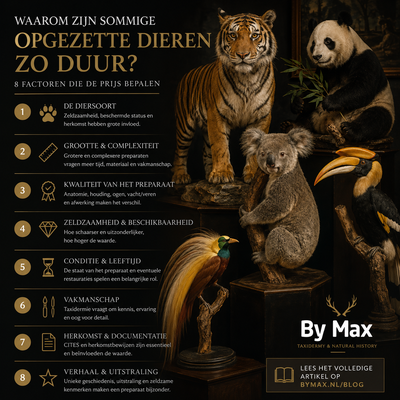
Why are some taxidermy animals so expensive? 8 factors that determine the price

Various special taxidermy animals such as a tiger, panda, koala and hornbill

Anyone looking at taxidermy for the first time may be surprised by the price differences between different specimens. One taxidermy animal may cost a few hundred euros, while another specimen can cost thousands of euros. How can that difference be so great?

The price of a specimen is determined by far more than just the animal species. Factors such as size, rarity, quality, condition, level of difficulty and finish all play an important role. In this article, we explain which factors determine the value of taxidermy.

1. The animal species

Not every animal species is equally easy to obtain, and not every species is equally easy to prepare. This affects the final price.

In addition, specific legal rules apply to certain animal species. For protected species, for example, CITES documentation may be required. The origin and available documentation are therefore important parts of assessing a specimen.

2. Size and complexity

A large specimen generally requires more material, time and craftsmanship than a small one. But the shape of the animal also plays a role.

A simply mounted animal cannot be compared with a complex specimen in which multiple parts have to be accurately built up and finished. The more attention a specimen requires during the process, the more this can affect its final value.

3. The quality of the specimen

Two specimens of the same animal species can differ considerably in quality. The anatomy, posture, eyes, fur or feathers and finish together determine how natural a specimen looks.

It is often the small details that make a big difference. A high-quality finish can therefore make a specimen considerably more valuable than one where the finishing is less meticulous.

Would you like to know what to look out for yourself? Then also read our article How do you recognise a high-quality taxidermy animal?.

4. Rarity and availability

Some animals are much more common in the world of taxidermy than others. When a particular specimen is difficult to find, this can affect its value.

This is not just about the animal species. An unusually large specimen, a striking colour variant or an exceptionally beautiful finish can also be rarer than an average specimen.

5. Condition and age

The condition of a specimen is an important factor. An old specimen that has been well preserved for years can still be particularly valuable. Age therefore does not automatically mean that a specimen is worth less.

With older specimens, we look at factors including discolouration, damage, insect damage and the overall condition of the animal. A professionally carried out restoration can also bring an older specimen back into excellent condition.

Want to know more about restoration? Then also view our information about taxidermy restoration.

6. The craftsmanship behind taxidermy

A good specimen does not happen by itself. Taxidermy requires knowledge of anatomy, materials and techniques, as well as a great eye for detail.

An animal’s posture must be natural, the proportions must be correct, and parts such as the eyes, ears, legs, claws or beak must be carefully finished. It is precisely these details that ensure a specimen looks convincing and natural.

Practical tip from By Max

When comparing two specimens, do not look only at the animal species or the size. Pay particular attention to the details. The quality of the eyes, the anatomy, the fur or feathers and the overall finish can make a big difference to both the appearance and the value of a specimen.

7. Origin and documentation

In taxidermy, a clear and verifiable origin is important. For certain protected animal species, additional legal requirements apply and CITES documentation may be necessary.

Documentation not only says something about the legal status of a specimen, but can also be important for the origin and the story behind a special piece.

Would you like to know more about CITES and the rules surrounding taxidermy? Then read our article What is CITES and why is it important in taxidermy?.

8. The story and the appearance

Some specimens have something that is difficult to express in a fixed pricing formula. A special specimen can have a strong presence, an interesting history or simply be exceptionally beautiful.

That is one of the special aspects of taxidermy. It is not just about an animal being prepared, but about preserving a piece of nature and presenting it as a unique object.

Why two similar specimens can still differ greatly in price

When comparing different specimens, it is therefore important not to look only at the size or the animal species. A small difference in quality, condition, finish or availability can cause a large difference in value.

You can compare it with art or antiques. Two objects may appear similar at first glance, but still differ greatly in quality, rarity and appeal.

In taxidermy, the craftsmanship of the taxidermist also comes into play. The way in which an animal has been built up and finished largely determines how natural the final result will be.

What should you look out for when buying taxidermy?

When buying a taxidermy animal, it is wise to look beyond the price alone. Check the quality of the specimen, pay attention to its condition and, for protected species, ask for the required documentation.

When purchasing online, it is also important that you can clearly see which specimen you are buying. At By Max, every specimen is photographed individually. The specimen you see on the website is therefore also the specimen you will receive.

This allows you to assess the posture, condition and finish yourself before making a purchase.

Frequently asked questions

Why are some taxidermy animals worth thousands of euros?
There can be several reasons for this. The animal species, size, rarity, quality, condition, finish and availability all play a role.

Is a large specimen always more expensive than a small specimen?
Not necessarily. Size is one of the factors, but quality, rarity, condition and craftsmanship also influence the value.

Is old taxidermy worth more?
Not automatically. An old specimen can be particularly valuable, but age alone does not determine its value. Condition, quality, origin and appearance are at least as important.

Does CITES affect the price of taxidermy?
Additional rules apply to certain protected animal species and documentation is required. The legal status and verifiable origin are important parts of assessing a specimen.

How do I know whether an expensive specimen is worth its price?
Do not look only at the price. Assess the quality, anatomy, posture, details, condition, finish and origin. If in doubt, a specialist can help assess a specimen.


The value of taxidermy lies in the whole

There is no simple formula with which you can calculate the value of every taxidermy animal. It is precisely the combination of animal species, quality, size, condition, rarity, craftsmanship and appearance that makes each specimen unique.

That is also what makes taxidermy so special. Every specimen has its own character and history. Ultimately, the value is not determined by one factor, but by the whole.

Curious about our collection? Then view our collection of taxidermy animals and taxidermy. Every specimen is photographed individually, so you can see exactly which one you are buying.

Do you have questions about a specific specimen, its quality, or its origin and documentation? Please feel free to contact us. We will be happy to help you assess a special piece.

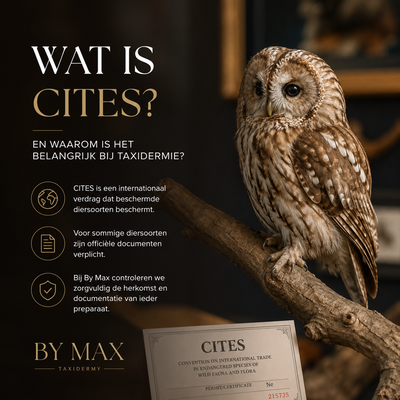
What is CITES and why is it important in taxidermy?

Explanation of CITES and the legislation surrounding taxidermy by By Max

Anyone who delves into taxidermy or taxidermy animals will sooner or later come across the term CITES . Especially for protected animal species, this international regulation is of great importance. But what exactly does CITES mean and why is it important when you buy a taxidermy animal?

In this article, we explain what CITES is, why it exists and what it means for collectors, enthusiasts and buyers of taxidermy.

What does CITES mean?

CITES stands for Convention on International Trade in Endangered Species of Wild Fauna and Flora. It is an international treaty that ensures trade in endangered animal and plant species takes place in a responsible manner. More than 180 countries have now joined this treaty.

The aim of CITES is not to ban all trade, but to ensure that protected species do not come under further pressure as a result of international trade.

Why is CITES important in taxidermy?

Not every taxidermy animal falls under CITES regulations. For some species, no additional rules apply, while for other species official documents or certificates are required.

When a specimen falls under CITES regulations, its origin must be demonstrable and the correct documents must be present. This allows a specimen to be legally sold, bought or – where permitted – traded internationally.

How does By Max handle this?

At By Max, we consider responsible business practices to be at least as important as craftsmanship. That is why we carefully check whether a specimen may be sold in accordance with the applicable laws and regulations. When a CITES certificate is required, we ensure that this documentation is present.

On our About us page you can read more about our vision on legal and responsible taxidermy and why we attach great importance to transparency.

Frequently asked questions

Are all taxidermy animals subject to CITES?
No. Only some animal species fall under CITES regulations. For many specimens, no additional documents are required.

Will I receive CITES documents?
When this is legally required, the necessary documents are supplied with the specimen.

Can I take a CITES specimen abroad?
That depends on the animal species and the country of destination. Transport within the EU is always permitted, but outside the EU this is not always the case. Always check the applicable regulations in advance.

Want to know more?

Are you curious about our collection? Then view our full range of taxidermy animals or discover our collection of skulls and skeletons. Each specimen on our website is unique and photographed individually.


Do you have questions about CITES, documentation or the origin of a specimen? Please feel free to contact us. We will be happy to advise you and provide a transparent explanation of the applicable regulations.