 EN
EN NL
NL DE
DE FR
FR
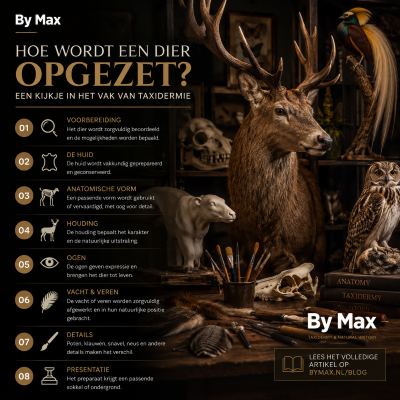
How is an animal actually turned into taxidermy? It is a question we regularly get at By Max. Many people see the final result of taxidermy, but give less thought to how much knowledge, preparation and craftsmanship goes into it beforehand.
Taxidermy is much more than placing a skin over a model. The anatomy, posture, proportions and finish all have to be carefully coordinated to achieve a natural result.
In this article, we take you into the world of taxidermy and explain in broad terms how an animal is mounted and which steps are involved.
What is taxidermy?
Taxidermy is the preservation and preparation of an animal, while retaining its appearance and natural form as well as possible. The aim is to give the animal a lifelike appearance.
Knowledge of the animal's anatomy is essential for this. A taxidermist must know how the body is structured, how the muscles and joints behave, and how the skin, fur or feathers naturally sit.
A good taxidermy piece therefore aims not only to preserve the appearance of an animal, but also its natural posture and character.
It starts with good preparation
Before an animal is actually prepared, the condition and possibilities of the specimen are assessed first. No two animals are the same, and the method can vary greatly depending on the species.
The taxidermist looks at the skin, fur or feathers, among other things, as well as any damage. It is also decided what posture the animal will ultimately have and how the taxidermy piece will be constructed.
Good preparation is important because much of the final quality is already determined during this stage.
The skin forms the basis
In many forms of taxidermy, the animal's skin is carefully prepared and preserved. Ultimately, the skin must fit as naturally as possible around the anatomical form of the taxidermy piece.
This is a precise process. The skin must not be unnaturally tight, but it must also not be placed too loosely or with folds. The natural proportions of the animal must be preserved.
With different animal species, this is approached in different ways. A bird, for example, requires a different method from a mammal.
The anatomical form
Once the skin has been prepared, the natural form of the animal has to be built up. A suitable anatomical base is used or made for this purpose.
The proportions must be accurate. The length of the body, the position of the legs, the shape of the chest and the position of the head all influence the final result.
This is one of the reasons why knowledge of anatomy is so important in taxidermy. A small deviation in the proportions can make an animal look unnatural.
The posture gives the animal character
A taxidermy piece is more than an anatomically correct body. The posture also largely determines how the animal is perceived.
A bird, for example, can sit calmly, look around alertly or adopt a more active pose. With a mammal, the position of the head, legs and tail can make the difference between a static and a lively appearance.
A natural posture must suit the animal. This takes into account the way the animal moves and behaves in nature.
The eyes are an important detail
The eyes play a special role in taxidermy. They largely determine the expression and appearance of the taxidermy piece.
The position, shape and direction of the eyes must suit the chosen posture. When this is done well, a natural gaze is created that gives the animal much more character.
That is precisely why the eyes are among the details to which an experienced taxidermist pays a great deal of attention.
Fur and feathers are carefully finished
Once the skin has been placed correctly, the fur or feathers are carefully arranged in their natural position.
With mammals, the fur must fall naturally and the hairs must follow the shape of the body. With birds, this is just as important for the feathers. The way the feathers lie on the wings, chest and tail, for example, largely determines how natural the taxidermy piece looks.
Here too, much of the craftsmanship lies in the details. A taxidermy piece may be anatomically correct, yet still look unnatural if the fur or feathers have not been finished properly.
The small details make the difference
When the main lines of the taxidermy piece are right, attention is paid to the smaller parts. Think, for example, of feet, claws, beak, nose, ears and other delicate details.
These parts are relatively small, but they have a major influence on the appearance of the whole piece. A carefully finished taxidermy piece therefore forms a cohesive whole in which all parts fit together.
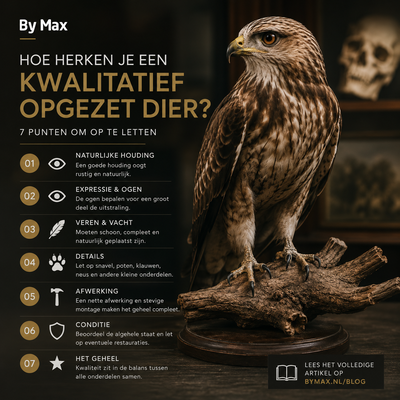
Would you like to know what to look out for yourself when assessing a taxidermy piece? Then also read our article How do you recognise a high-quality taxidermy animal?.
A suitable base or surface
The presentation of a taxidermy piece is also part of the final result. An animal can, for example, be placed on a wooden base, a natural surface or another suitable structure.
The surface should complement the animal without drawing attention away from it. For some taxidermy pieces, a simple presentation is deliberately chosen, while another posture may call for a more elaborate base.
How long does it take to mount an animal?
There is no general timeframe for this. The time required depends greatly on the animal species, the size of the animal, the chosen posture and the desired finish.
A small taxidermy piece can take considerably less time than a large and complex animal. Unusual postures or elaborate bases can also involve additional work.
That is why taxidermy is not a production process in which every animal is finished in exactly the same amount of time. Each taxidermy piece requires its own approach.
Why does one taxidermy piece look more natural than another?
The difference often lies in a combination of factors. The anatomy must be correct, the posture must be natural, and the skin, fur or feathers must be carefully finished.
The eyes and small details also play an important role. It is precisely when all these elements come together well that a taxidermy piece looks natural and convincing.
That is also why two taxidermy pieces of the same animal species can still look very different.
Craftsmanship lies in the details
At By Max, when it comes to taxidermy, we do not look only at the final result. It is precisely the small details that say a lot about the quality of a taxidermy piece: from the anatomy and posture to the eyes, feathers, fur and finish.
Taxidermy is a combination of knowledge and craftsmanship
Mounting an animal requires more than technical skills. A taxidermist must have knowledge of anatomy and materials, but also a feel for proportions, posture and detail.
The ultimate goal is always the same: to create a taxidermy piece in which the character and natural appearance of the animal are preserved as well as possible.
This makes every taxidermy piece unique. Even within the same animal species, the appearance, posture and finish can vary greatly.
From preparation to restoration
Not every taxidermy piece that comes to By Max needs to be made from new. Older taxidermy pieces can sometimes also be brought back into good condition through restoration.
During restoration, the condition of the taxidermy piece and the nature of any damage are assessed first. It is then determined which work is needed to make the animal look as good as possible again.
Want to know more about maintaining a taxidermy piece? Then also read our article How do you care for a taxidermy bird?.
Frequently asked questions about taxidermy
What does taxidermy mean?
Taxidermy is the preparation and preservation of animals while retaining their appearance and natural form as well as possible.
How is an animal mounted?
The process differs per animal species, but broadly consists of preparing the animal, preserving and preparing the skin, building up the anatomical form and carefully finishing the posture, eyes, fur or feathers and other details.
Is every animal mounted in the same way?
No. The method differs between birds, mammals and other animal groups, among others. The size, condition and desired posture of an animal also influence the method.
How long does taxidermy take?
This varies greatly per taxidermy piece. A small animal usually requires a different amount of work than a large or complex taxidermy piece.
Can an old taxidermy piece be restored?
In many cases, taxidermy can be restored. The possibilities depend on the condition and the nature of any damage.
Want to know more about taxidermy?
At By Max you will find an extensive collection of taxidermy and taxidermy animals. Each taxidermy piece is unique and photographed individually, so you can see exactly which specimen you are buying.
Curious about our way of working and the story behind By Max? Read more about By Max.
Do you have questions about taxidermy, a specific taxidermy piece or the options for restoration? Please feel free to contact us. We will be happy to help you further.